
Structural optimization problem
Published:
As part of my personal goal to improve my writing skills, I will be posting several notes (or documentation) I use in learning some tools or concepts I utilize in my current research. These topics will be mostly about structural reliability, optimization and disaster risk. Along the way, I will be able to deepen my understanding on the fundamental principles and at the same time practice to articulate ideas in a clear and concise manner.
For this post, my topic will be on structural optimization.
Optimization as an engineering tool
I have learned about optimization during my master’s degree studies. I was extremely fascinated by how mimicking the behavior of flocking animals can be used to solve engineering problems. It was very rewarding that we were tasked to manually code our own particle swarm optimizer.
I see optimization technique as a tool that engineers can (or should) use in design tasks or decision making. One of the main task of a structural engineer is to decide the building design specifications, that is, materials to be used, dimension and cross-sectional areas of the structure and many more. Due to plenty of design choices to make: what materials to use? what should the dimension of the columns, beams, etc.? Structural design is best framed as an optimization problem (OP). Mathematically, it is formally stated as
\[\begin{aligned} \text{Find} \: & x^{\ast} \: \text{that} \\ \min_{x} \: & f(x) \\ \text{subject to} \: & g_i(x) \le 0, \quad i = 1,\dots,m \\ & h_j(x) = 0, \quad j = 1,\dots,p \end{aligned}\]The primary goal is to find the best design or optimal design $x^{\ast}$ that will minimize the objective function $f(\cdot)$ and satisfy the constraint functions, $g_i(\cdot)$ and $h_j(\cdot)$. This is a standard constrained OP. In structural optimization, the common objective function to be minimized is the construction or material costs of the building while the constraints are often related to achieveng deformation or stress threshold requirements. The standards (geometric, deformation and strength) set by building codes are usually the constraints used in structural optimization.
Solution to the OP stated above are extensively described in [1] and [2]. The primary hurdle in using optimization in engineering design would be the computational cost, that is, either evaluating the objective function or the constraint functions. For example, if the design you are doing requires performing a nonlinear structural analysis then doing the iterative nature of optimization solutions can be prohibitive.
How structural design fits the optimization problem?
A simple structure is used to demonstrate the application of the optimization framework to structural design problems is hereby explained. The figure shown below is a truss structure with three members and an applied load at the free end of each member [3].
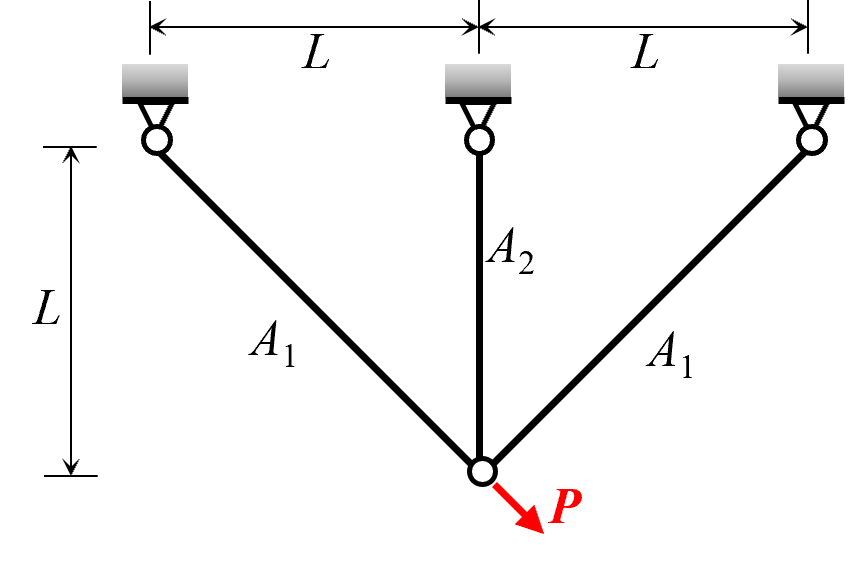
Using principle of structural analysis, the stresses ($\sigma_i, i=1,2,3$) for each truss member can be expressed as
\[\begin{aligned} \sigma_1 & = \frac{\sqrt{2} A_1 + A_2 }{\sqrt{2}A_1^2 + 2A_1 A_2} P \\ \sigma_2 & = \frac{1 }{\sqrt{2}A_2 + A_1 } P \\ \sigma_3 & = \frac{A_2 }{\sqrt{2}A_1^2 + 2A_1 A_2} P \end{aligned}\]As a structural designer, one has to balance safety and economy. For a given force $P$, the engineer should decide what are the values of the cross sections $A_1, A_2, A_3$ of each truss member subject to a minimum allowable stresses. For example, an allowable stress threshold, $\bar{\sigma} = 20 \: \text{MPa}$ can be set. The same with the threshold $\bar{\sigma}$, the load force $P$ or load demand is normally set by building codes. The objective is to minimize the cost of the structure which is proportional to the volume of the construction materials ($\text{Volume}\: = (2\sqrt{2}A_1 + A_2) \times L$). Thus, the structural optimization problem can be stated as
\[\begin{aligned} \min_{x} \quad & f(x) = (2\sqrt{2}A_1 + A_2) \times L \\ \text{subject to} \quad & \sigma_1 = \frac{\sqrt{2} A_1 + A_2 }{\sqrt{2}A_1^2 + 2A_1 A_2} P \le 20 \: \text{MPa} \\ & \sigma_2 = \frac{1 }{\sqrt{2}A_2 + A_1 } P \le 20 \: \text{MPa} \\ & \sigma_3 = \frac{A_2 }{\sqrt{2}A_1^2 + 2A_1 A_2} P \le 20 \: \text{MPa} \\ \end{aligned}\]where $x = [A_1,A_2 ]$. In this example, it is shown how a structural engineering problem is viewed in an optimization framework. Optimization as a mathematical tool is also widely applied to problems present in fields like operations research, machine learning, business management etc. The optimal design can then be selected by using available optimization tools that can solve the problem above.
Reference
- Nocedal, J., & Wright, S. J. (2006). Numerical optimization (2nd ed). Springer.
- Martins, J. R. R. A., & Ning, A. (2022). Engineering design optimization. Cambridge University Press. https://doi.org/10.1017/9781108980647
- Ray, T., & Saini, P. (2001). Engineering design optimization using a swarm with an intelligent information sharing among individuals. Engineering Optimization, 33(6), 735–748. https://doi.org/10.1080/03052150108940941